
Comprehensive Vehicle Inspection Before a Long Journey or Travelling Abroad

A long journey places significantly more strain on a vehicle than short daily trips around the city. Prolonged driving at high speed, queues at border crossings, temperature changes, mountain roads, and a fully loaded passenger compartment may reveal faults that were previously barely noticeable.
For this reason, it is worth arranging a comprehensive vehicle inspection in Lviv before travelling. The inspection helps assess the condition of the engine, braking system, suspension, tyres, battery, lighting, and operating fluids. Preparing the vehicle before travelling abroad is especially important because finding a service station, spare parts, or a recovery vehicle may take longer and cost more.
You can have your vehicle inspected before the journey at the «Autopark-Service» service station in Solonka, near the Lviv ring road.
When to Have Your Vehicle Checked Before a Journey
A comprehensive inspection is recommended not only before a journey of several thousand kilometres. You should visit a service station if:
- the vehicle has not been serviced for a long time;
- a long motorway journey is planned;
- you are planning to travel abroad;
- the route passes through mountainous areas;
- the vehicle will be fully loaded;
- unusual noises, vibrations, or dashboard warning lights have appeared;
- the vehicle has been left unused for a long time;
- the engine, suspension, or braking system has recently been repaired;
- you are planning to travel with children;
- the vehicle will be used to tow a trailer.
It is best to book the inspection several days before departure. If any faults are found, there will still be time for repairs and a final inspection.
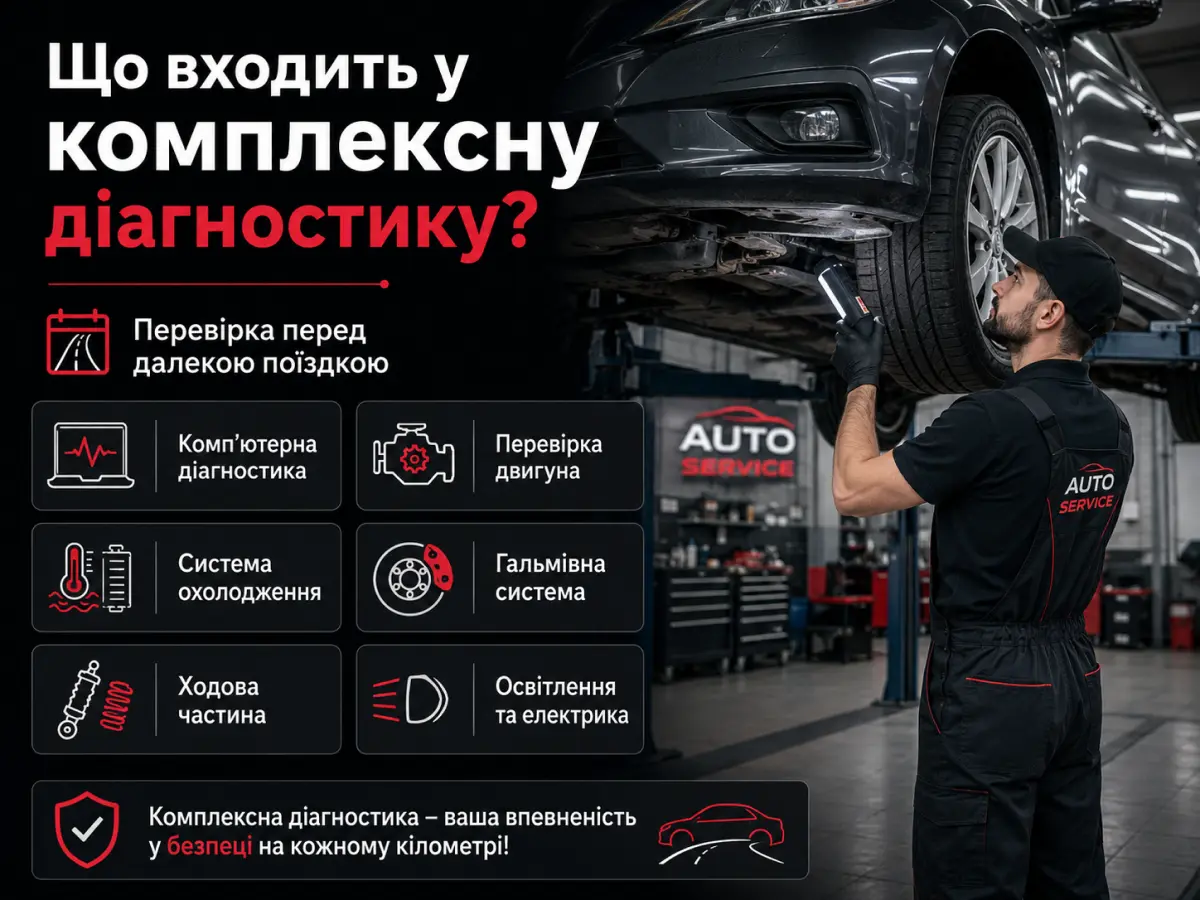
What Is Included in a Comprehensive Vehicle Inspection?
The scope of work depends on the make, model, mileage, and condition of the vehicle. A complete inspection before a long journey should cover the main systems that affect the vehicle’s safety and reliability.
Computer Diagnostics
The electronic control units in a modern vehicle continuously monitor the engine, transmission, ABS, stability control system, airbags, and other equipment. Some faults may remain stored in the memory even when no warning light is displayed on the dashboard.
During computer diagnostics, the technician:
- reads active and stored fault codes;
- checks the engine’s actual operating parameters;
- assesses sensor readings;
- monitors temperature and voltage;
- checks the operation of electronic systems;
- determines whether an individual component requires further diagnostics.
Clearing a fault code without eliminating its cause is not a repair. Before a long journey, it is important to understand why the warning appeared and whether the fault could recur on the road.
Engine Inspection
During a long journey, the engine may operate for hours without stopping, so even a minor leak or unstable operation may lead to serious consequences.
Before departure, the following are checked:
- the engine oil level and condition;
- whether there are any leaks;
- the condition of the drive belts;
- hoses and connections;
- the operation of the ignition system;
- the fuel system;
- unusual noises;
- smooth engine operation at idle;
- control unit fault codes.
If the engine has lost power, produces smoke, is difficult to start, or consumes more oil, the cause should be identified before the journey begins.
Cooling System Diagnostics
Engine overheating is one of the most dangerous faults that can occur on the road. The load is particularly high in summer, in queues at border crossings, on mountain climbs, and while driving with the air conditioning switched on.
During the cooling system inspection, the following are assessed:
- the antifreeze level and condition;
- the tightness of the hoses;
- the condition of the radiator;
- the operation of the fan;
- the condition of the thermostat;
- the condition of the water pump;
- the expansion tank cap;
- whether there are signs of leakage.
If the coolant level keeps falling, simply topping it up is not enough. The source of the antifreeze loss must be identified.
Braking System Inspection
During a long journey, the brakes may operate under increased load, especially on descents, in heavy traffic, and when the vehicle is fully loaded.
The diagnostics may include:
- assessing the thickness of the brake pads;
- checking the brake discs;
- inspecting the hoses and pipes;
- checking the brake fluid level;
- checking for leaks;
- ABS diagnostics;
- checking the parking brake;
- assessing brake pedal operation.
Squeaking, steering wheel vibration, increased braking distance, or the vehicle pulling to one side should not be ignored.
Suspension and Steering Diagnostics
On unfamiliar roads, the driver may not always notice a pothole or another uneven surface in time. Worn suspension components reduce vehicle control and may create a danger at high speed.
Before the journey, the following should be checked:
- shock absorbers;
- springs;
- ball joints;
- silent blocks;
- steering rods and track rod ends;
- wheel bearings;
- CV joints;
- protective boots;
- play in the suspension;
- component fasteners.
Knocking on uneven roads, humming while driving, steering wheel vibration, or unstable vehicle behaviour are reasons to arrange more detailed diagnostics.
Tyre and Wheel Inspection
Tyres directly affect braking distance, handling, and vehicle stability. Before a long journey, the following should be checked:
- remaining tread depth;
- whether the wear is even;
- whether there are cuts or cracks;
- the condition of the sidewalls;
- tyre pressure;
- wheel balancing;
- the condition of the wheel rims;
- the tightness of the fasteners.
Tyre pressure should be adjusted according to the vehicle load. The recommended values are usually specified by the manufacturer on the bodywork, fuel filler flap, or in the owner’s manual.
The spare wheel or tyre repair kit should also be checked. A spare tyre with insufficient pressure will not help in the event of a puncture.
Battery and Alternator Inspection
Engine starting problems may occur after a long stop, overnight parking, or using a large amount of electrical equipment.
During the inspection, the following are checked:
- battery voltage;
- the battery’s ability to retain a charge;
- alternator operation;
- the condition of the terminals;
- whether there is any oxidation;
- drive belt tension;
- possible parasitic current drain.
It is particularly important to check the battery if the engine starts more slowly, the lights become dimmer, or the charging warning light has appeared on the dashboard.
Lighting and Electrical Equipment
Before travelling abroad, the vehicle must have fully functioning exterior lighting. The following should be checked:
- dipped and main beam headlights;
- direction indicators;
- brake lights;
- position lights;
- fog lights;
- number plate lighting;
- hazard warning lights;
- windscreen wipers;
- windscreen washer;
- the horn.
Even a faulty bulb may create a dangerous situation at night or during rainfall.
Air Conditioning and Ventilation System
During a summer journey, a faulty air conditioning system causes more than discomfort. High cabin temperatures increase driver fatigue and reduce concentration.
Before the journey, it is worth checking:
- cooling efficiency;
- the operation of the cabin fan;
- unusual compressor noises;
- the condition of the drive belt;
- whether there is an unpleasant smell;
- the cabin filter;
- condensate drainage.
If the air conditioning does not cool effectively, simply recharging it may not be sufficient. The system should first be checked for leaks.
Operating Fluid Inspection
Before a long journey, the level and condition of the following fluids are checked:
- engine oil;
- antifreeze;
- brake fluid;
- transmission fluid, if required by the vehicle design;
- power steering fluid;
- windscreen washer fluid.
Fluids with different specifications should not be mixed simply because they have a similar colour. Any product used for topping up should meet the requirements of the specific vehicle.

Should the Oil Be Changed Before a Long Journey?
The need for replacement depends not only on mileage but also on the period of use, driving conditions, and the manufacturer’s recommendations. If the scheduled service is due soon, it is better to complete it before departure.
When necessary, the following are replaced together with the oil:
- the oil filter;
- the air filter;
- the fuel filter;
- the cabin filter.
Do not postpone servicing until after your return if the recommended interval will be exceeded during the journey.
Special Considerations for Inspecting a Diesel Vehicle
Before a long journey in a diesel vehicle, it is also worth checking:
- the fuel injectors;
- the fuel filter;
- turbocharger operation;
- the EGR system;
- the condition of the diesel particulate filter;
- the AdBlue system, if fitted;
- the glow plugs;
- the tightness of the fuel system.
If the diesel engine is difficult to start, has lost power, or has entered limp mode, the fault should be repaired before departure.
What Should Be Kept in the Vehicle During the Journey?
In addition to the equipment required for the planned route, it is useful to have:
- a spare wheel or tyre repair kit;
- a jack and wheel wrench;
- a compressor or pump;
- a towing rope;
- jump leads;
- a torch;
- spare windscreen washer fluid;
- work gloves;
- wipes and water;
- a phone charger.
You should also check the validity of your documents and insurance and review the requirements of the countries through which the route will pass. The rules may differ, so they should be checked immediately before departure.
Which Faults Must Not Be Ignored Before the Journey?
It is better to postpone the journey if:
- the engine is overheating;
- the oil pressure warning light is on;
- there is a fuel or brake fluid leak;
- the vehicle brakes inconsistently;
- the suspension is knocking heavily;
- there is excessive play in the steering;
- the tyres are damaged;
- the engine runs unevenly;
- the transmission jerks or slips;
- the antifreeze level keeps falling;
- the ABS, brake system, or charging warning lights are on;
- there is a loud wheel bearing hum.
A fault that appears minor in Lviv may become more serious after several hours of motorway driving.
Why You Should Not Have the Vehicle Checked on the Last Day
It is better to arrange a comprehensive inspection in advance. If a problem is found, the following may be required:
- ordering spare parts;
- further inspection;
- repairs;
- adjustment;
- a test drive;
- repeat diagnostics.
If you visit a service station immediately before departure, there may not be enough time to repair the faults properly.
Comprehensive Vehicle Inspection in Lviv, Solonka
Before a long journey or travelling abroad, we recommend arranging a comprehensive vehicle inspection at the «Autopark-Service» service station. The technicians can inspect the engine, suspension, braking system, electronics, operating fluids, battery, and other important components.
The service station is located at 60 Kiltseva Street in Solonka, near the Lviv ring road. This location is convenient for drivers from Lviv and those preparing to travel towards international routes.
Timely diagnostics help identify hidden faults, prepare the vehicle for prolonged loads, and reduce the risk of a breakdown far from home.
Frequently Asked Questions
How many days before the journey should the vehicle be checked?
Ideally, the inspection should be completed several days before departure. This leaves time to order spare parts, carry out repairs, and perform a final inspection.
Are computer diagnostics alone sufficient?
No. Computer diagnostics show the condition of the electronic systems but do not replace an inspection of the suspension, brakes, tyres, leaks, and mechanical components.
Does a new vehicle need to be inspected?
Even a relatively new vehicle should be inspected before a long journey. The tyre pressure, fluid levels, lighting, battery, and absence of damage should be checked.
What should be checked before driving in the mountains?
Particular attention should be paid to the brakes, cooling system, tyres, transmission, and engine. These components operate under increased load on climbs and descents.
Where can I have my vehicle inspected before travelling abroad from Lviv?
A comprehensive vehicle inspection is available at the «Autopark-Service» service station at 60 Kiltseva Street in Solonka.