
Timing Belt or Timing Chain: When to Replace It and What Happens If It Breaks
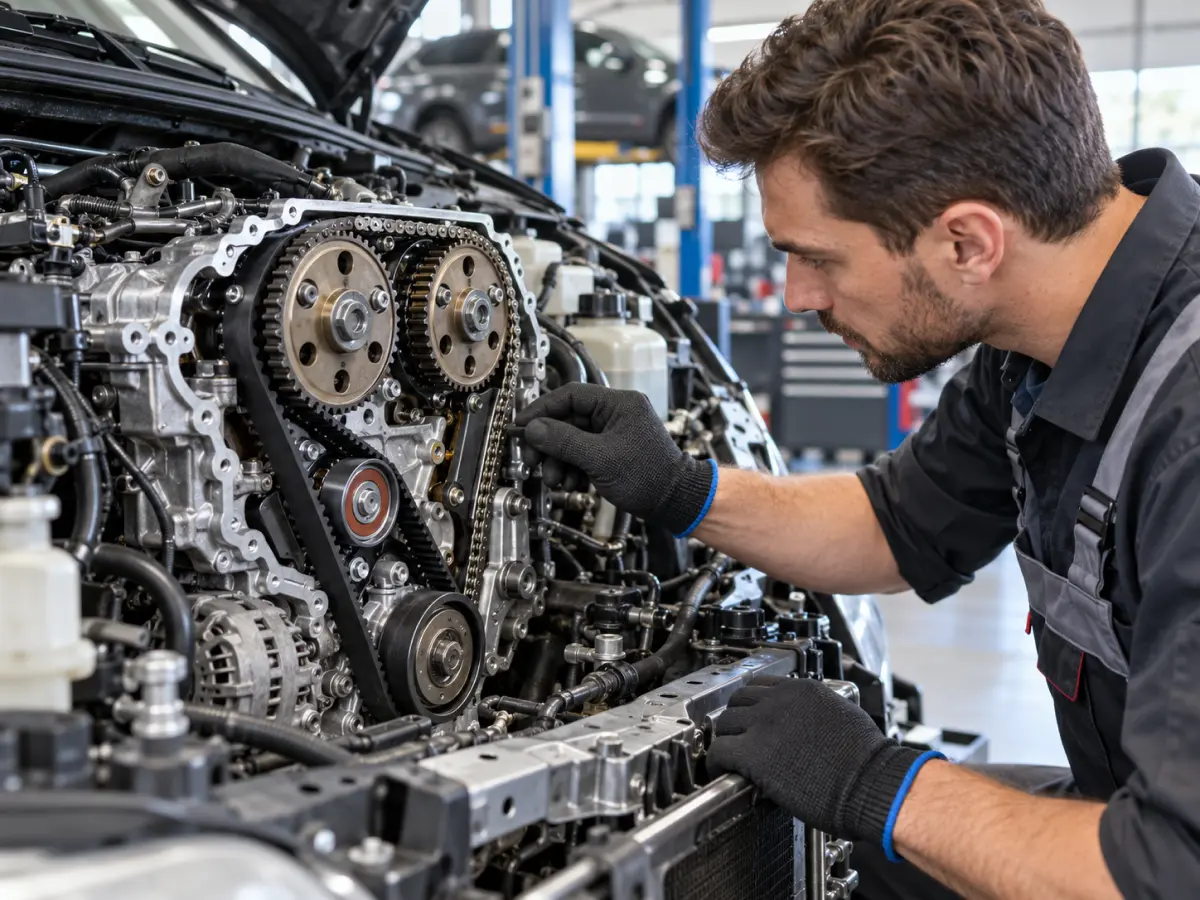
In short: a timing belt is usually replaced every 60–120 thousand km or every 4–6 years, depending on the engine. A timing chain lasts longer, but its condition should be checked after 150 thousand km. If the belt or chain breaks on an interference engine where the valves can come into contact with the pistons, the pistons will hit the valves, and cylinder head repairs may cost several times more than scheduled replacement.
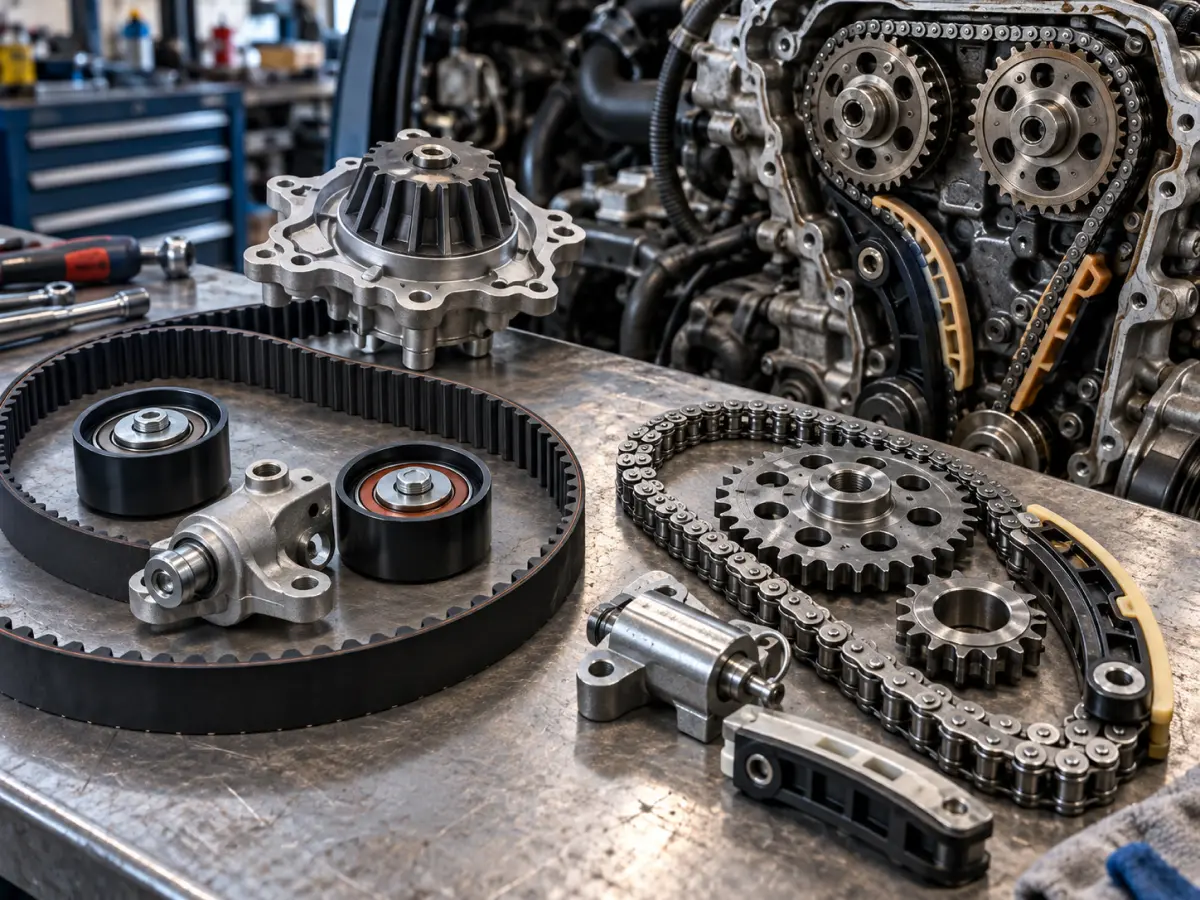
The timing system synchronizes the rotation of the crankshaft and camshaft. It ensures that the valves open and close at the correct moment. There are three main types of timing drive: a dry timing belt, a «wet» belt running in oil, and a metal timing chain.
What Is the Difference Between a Timing Belt and a Timing Chain?
| Parameter | Timing Belt | «Wet» Belt in Oil | Timing Chain |
| Typical service life | 60–120 thousand km or 4–6 years | 100–240 thousand km or 6–10 years, according to the manufacturer’s maintenance schedule | 150–300 thousand km, depending on the engine and oil |
| How it wears | Cracks, delamination, worn teeth | Swells and deteriorates, with debris clogging the oil pickup | Stretches, while the tensioner and guides wear out |
| Warning signs before failure | Often none | Low oil pressure, fault codes | Rattling on a cold start, camshaft/crankshaft correlation errors |
| Engine examples | Many petrol and diesel VW, Renault, Skoda, and Hyundai engines | Ford 1.0 EcoBoost, Peugeot/Citroen 1.2 PureTech | VW 1.2/1.4 TSI, 1.8/2.0 TFSI, BMW N47, many Toyota engines |
| What is replaced together | Idlers, tensioner, and often the water pump | Idlers, tensioner, oil, and oil pickup screen | Tensioner, guides, and sprockets |
The exact replacement interval for your vehicle is specified in the service manual. At our service station, we verify it using the VIN because the same vehicle model may be equipped with different engines.
When to Replace the Timing Belt
The timing belt should be replaced based on mileage or age, whichever comes first. Rubber deteriorates even when the vehicle is driven very little. Therefore, a belt on a car that has covered only 40 thousand km over 7 years should also be replaced.
The belt should be replaced ahead of schedule if you notice:
- cracks or delamination on the belt during inspection;
- oil or coolant traces on the belt, as these fluids damage the rubber;
- whistling, rustling, or humming noises from the timing drive area;
- an unknown maintenance history after purchasing a used vehicle.
Based on our experience, timing belts in Lviv may wear faster than the official maintenance interval suggests. Short city trips, traffic jams on Horodotska Street, and cold winter starts place more stress on the system than steady highway driving. Therefore, for vehicles mainly used in the city, we recommend using the lower end of the replacement interval.
When to Replace the Timing Chain
A timing chain does not have a fixed replacement interval. Its condition is assessed based on symptoms and diagnostics. Signs of a stretched timing chain include:
- metallic rattling for 1–3 seconds after a cold start;
- P0016, P0017, P0008 fault codes indicating crankshaft and camshaft correlation issues;
- rough idle and loss of power;
- on VW TSI engines — a «rattling» sound when starting after a freezing night.
At our service station, we check the timing chain using computer diagnostics and monitor valve timing deviations in real time. If necessary, we remove the cover and measure the tensioner travel. This allows us to assess wear without disassembling the entire engine.
What Happens If the Timing Belt Breaks?
The consequences depend on the engine design. In most modern engines, the piston and valve can occupy the same space at different moments. These are known as interference engines.
| Engine Type | What Happens When the Belt Breaks | Consequences |
| Interference engine (most modern petrol engines and all diesel engines) | The pistons hit the open valves | Bent valves, damaged valve guides, and in some cases damaged pistons and cracks in the cylinder head |
| Non-interference engine (some older naturally aspirated engines) | The engine simply stops | Installing a new timing kit is usually sufficient |
On diesel engines, the consequences are usually more severe because of the high compression ratio. Repairs after a timing belt failure often involve removing the cylinder head, replacing valves, machining valve seats, and installing a new gasket. This type of repair can take several days.
If the timing belt breaks while driving, do not try to restart the engine. Every additional starting attempt can cause further damage. Call a tow truck and bring the vehicle in for diagnostics.
What Is Included in Timing System Replacement at Autopark-Service?
- We identify the engine using the VIN and select either an original kit or a high-quality alternative from brands such as Gates, Contitech, INA, or SKF.
- We replace the timing belt or chain together with the idlers, tensioner, and, when necessary, the water pump.
- We set the timing using locking tools designed for the specific engine rather than relying on «visual timing marks».
- For «wet» timing belts, we replace the engine oil and clean the oil pickup.
- After replacement, we verify the timing using computer diagnostics and perform a test start.
Replacing only the belt without the idlers is not recommended. A seized idler can damage a new belt just as easily as an old one.
How Much Does Timing Belt or Timing Chain Replacement Cost in Lviv?
The price depends on the engine, the complexity of the work, and the parts kit used. On some vehicles, removing the protective cover is sufficient, while on others the subframe must be lowered. We provide the exact cost after inspection and agree it with you before starting the work.
Book a timing system replacement in Lviv: phone +380 91 481 9004, address 60 Kiltseva St. We are open 24/7, so you can leave your vehicle in the evening and pick it up in the morning. Learn more about engine services on the engine repair page.
Frequently Asked Questions
How Often Should the Timing Belt Be Replaced?
Usually every 60–120 thousand km or every 4–6 years, whichever comes first. The exact interval is specified by the engine manufacturer.
Can I Keep Driving If the Timing Chain Rattles on a Cold Start?
You may be able to drive for a short period, but the rattling indicates wear of the tensioner or chain. If the chain jumps a tooth, the engine can suffer the same type of damage as it would after a timing belt failure.
Should the Water Pump Be Replaced Together with the Timing Belt?
Yes, if the water pump is driven by the timing belt. Its service life is usually similar to that of the belt, and replacing it later would mean paying for much of the same labor again.
Which Is More Cost-Effective — a Timing Belt or a Timing Chain?
A timing chain lasts longer, but replacement is more expensive. A timing belt is cheaper to replace, but it needs to be replaced more frequently and on time.
How Can I Find Out Whether My Engine Is an Interference Engine?
Tell us the model and year of your vehicle or provide the VIN. A technician will check the engine design and explain how serious the consequences of a timing system failure could be.
Read also: what to replace every 10, 30, and 50 thousand km, what is included in an engine overhaul.