
Car Lost Power: What to Check First

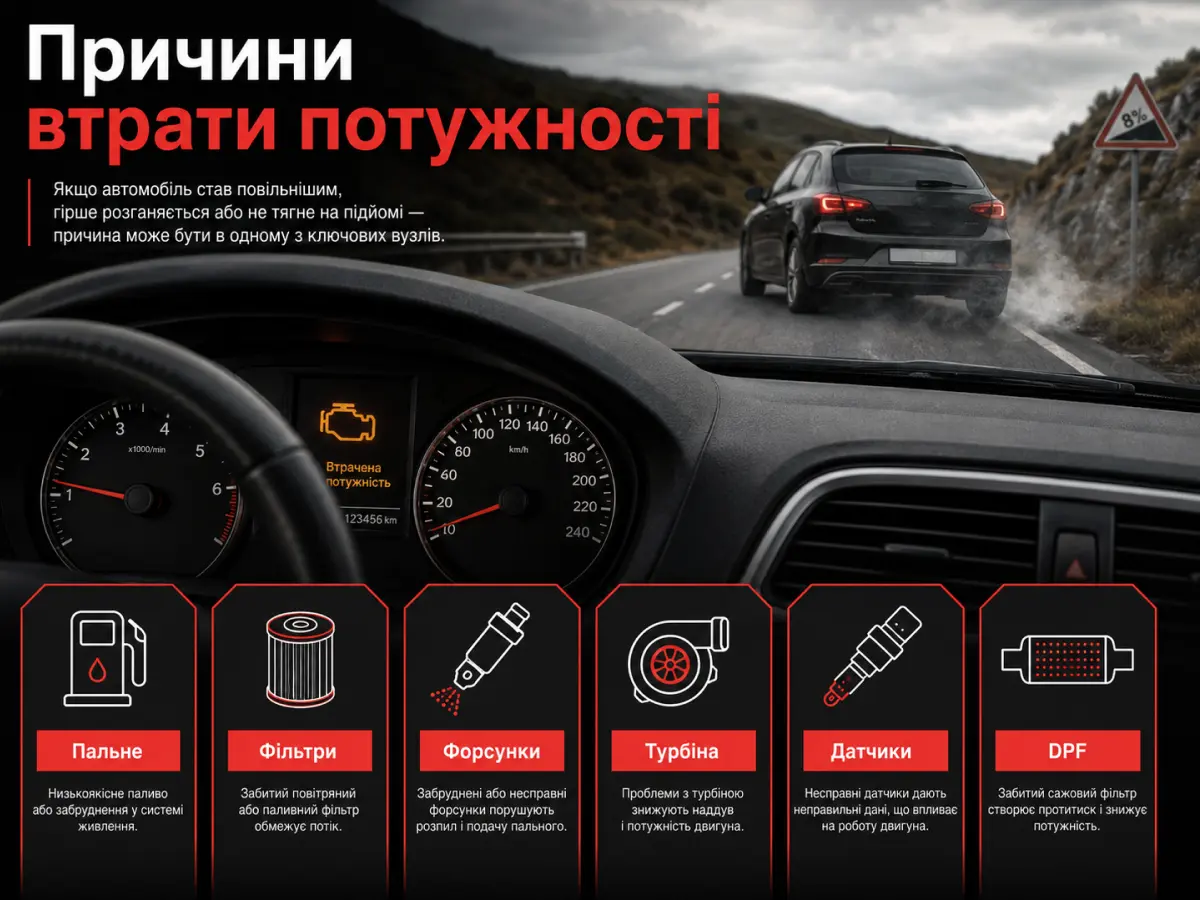
If your car has lost power, accelerates slowly, responds poorly to the accelerator pedal, or “does not pull” uphill, this does not always mean a serious engine failure. Sometimes the cause may be a clogged filter, a faulty sensor, fuel problems, or an ignition system issue. However, such symptoms should not be ignored, as a minor fault can quickly turn into an expensive repair.
Loss of engine power is a signal that the vehicle is not operating normally. To avoid replacing parts at random, it is important to start with proper diagnostics. In this article, we will explain why a car loses traction, what to check first, and when it is better to contact a service station immediately.
How to Understand That Your Car Has Lost Power
Drivers usually notice quite quickly when a car starts behaving differently than before. The main signs of power loss include:
- the car accelerates more slowly;
- the engine hesitates when pressing the accelerator;
- the car struggles to drive uphill;
- jerking appears while driving;
- fuel consumption has increased;
- the car does not gain revs;
- the engine misfires or runs unevenly;
- black, white, or blue smoke appears from the exhaust;
- the Check Engine light comes on;
- the car switches to limp mode.
If the symptoms appear suddenly, especially together with smoke, unusual noise, or overheating, it is better not to continue driving without diagnostics.
1. Check Fuel Quality
One of the simplest and at the same time most common reasons is poor-quality fuel. If the car lost power after refueling, started jerking, or became harder to start, fuel quality should be one of the first things to consider.
Bad fuel can affect the operation of the injectors, fuel pump, filters, and the entire fuel supply system. This is especially critical for diesel vehicles, where the fuel system is very sensitive to contamination.
What may indicate a fuel problem:
- the car started driving worse immediately after refueling;
- the engine runs unevenly;
- jerking appeared;
- fuel consumption increased;
- the car is difficult to start.
In this case, you should not wait for the problem to go away on its own. It is necessary to check the fuel filter, fuel system pressure, and injector operation.
2. Air Filter
The engine needs not only fuel but also a sufficient amount of air. If the air filter is clogged, the engine does not receive the proper volume of air mixture. As a result, the car may lose power, accelerate worse, and consume more fuel.
This is one of the simplest causes that should be checked first. Especially if the filter has not been replaced for a long time or the vehicle often drives on dusty roads.
Signs of a clogged air filter:
- the car gains speed slowly;
- the engine “struggles to breathe” at high revs;
- fuel consumption has increased;
- accelerator response has worsened.
Replacing the filter is an inexpensive procedure, but it can noticeably affect engine performance.
3. Fuel Filter
If the fuel filter is clogged, the engine does not receive enough fuel. Because of this, the vehicle may lose power during acceleration, uphill driving, or under load.
For diesel vehicles, this is especially important. A dirty fuel filter can create additional load on the fuel pump and injectors.
When to check the fuel filter:
- the car does not pull during acceleration;
- the engine stalls or runs unstably;
- the car loses power at high speed;
- the car starts poorly;
- scheduled maintenance has not been performed for a long time.
If the car is losing traction gradually rather than suddenly, the fuel filter is one of the first components to check.
4. Spark Plugs or Glow Plugs
In gasoline vehicles, worn spark plugs are often the cause of power loss. If they are worn out, the engine may misfire, start poorly, run with interruptions, and lose dynamics.
In diesel vehicles, glow plugs play an important role. They especially affect engine starting in cold weather. However, starting problems may also be accompanied by unstable engine operation.
Signs of plug-related problems:
- the engine misfires;
- the car jerks;
- poor starting;
- unstable idle operation;
- fuel consumption has increased;
- the car accelerates worse.
Spark plugs should be checked together with ignition coils, wiring, and errors in the electronic control unit.
5. Injectors
Injectors are responsible for the correct fuel supply to the engine. If they are dirty or not working properly, the car may lose power, start smoking, misfire, or start poorly.
Diesel vehicle owners face this problem especially often. Faulty injectors can cause fuel overflow, uneven engine operation, increased fuel consumption, and heavy smoke from the exhaust pipe.
Signs of faulty injectors:
- the car has lost traction;
- the engine runs unevenly;
- black smoke appeared;
- fuel consumption increased;
- the vehicle is difficult to start;
- the engine misfires;
- jerking appeared while driving.
Injector testing requires special equipment. Therefore, it is better not to draw conclusions based only on symptoms, but to have diagnostics performed at a service station in Lviv.
6. Turbocharger
If a car with a turbocharged engine has lost power, the turbocharger must be checked. A faulty turbocharger or boost system problems often appear as a sharp drop in traction.
The driver may feel that the car “does not drive,” gains speed slowly, or no longer has the usual acceleration after pressing the gas pedal.
Symptoms of turbocharger problems:
- the car has lost power;
- a whistle or unusual noise appeared;
- the engine accelerates poorly;
- blue or black smoke comes from the exhaust pipe;
- oil consumption has increased;
- the car switches to limp mode.
It is important not to delay checking the turbocharger. If you continue driving with a fault, you may damage not only the turbocharger but also the engine.
7. Engine Sensors
A modern car depends on many sensors. If one of them sends incorrect data, the engine may operate improperly. This can lead to loss of power, increased fuel consumption, jerking, or a Check Engine error.
The following sensors are most often checked:
- mass air flow sensor;
- boost pressure sensor;
- oxygen sensor;
- throttle position sensor;
- temperature sensor;
- crankshaft or camshaft position sensor.
It is difficult to identify a faulty sensor on your own. For this, computer diagnostics of the vehicle are required. It helps read errors and understand which system has a problem.
8. Exhaust System, Catalytic Converter, or DPF
If the exhaust system is clogged, it becomes difficult for the engine to “breathe out.” Because of this, the car may lose power, gain revs poorly, and switch to limp mode.
In gasoline vehicles, the problem is often related to the catalytic converter. In diesel vehicles, it is often related to the DPF particulate filter. If the DPF is clogged, the car may lose traction, smoke more, or display dashboard errors.
Signs of exhaust system problems:
- the car does not gain revs;
- loss of traction at speed;
- DPF or catalytic converter errors;
- increased fuel consumption;
- the engine operates under load;
- the car switches to limp mode.
In such a situation, it is important not simply to “clear the error,” but to find the reason why the system became clogged or is not working correctly.
9. Engine Problems
If simple causes have been ruled out, the engine itself must be checked. Loss of power may be related to low compression, wear of the piston group, valve problems, a cylinder head gasket issue, or the timing system.
Such faults are usually accompanied by additional symptoms:
- the engine misfires;
- the car smokes;
- there is knocking or unusual noise;
- the oil level drops;
- overheating occurs;
- the engine starts poorly;
- compression is below normal.
In this case, deeper engine diagnostics are required. This may include compression testing, endoscopic inspection, checking the timing system, system tightness testing, and inspection of other components.
10. Limp Mode
Sometimes a car loses power not because of a mechanical failure, but because it has switched to limp mode. The electronics limit power to protect the engine or transmission from damage.
Limp mode may be caused by:
- turbocharger errors;
- fuel system problems;
- faulty sensors;
- DPF problems;
- overheating;
- transmission errors;
- reduced boost pressure.
If the car has switched to limp mode, you should not simply clear the errors. Diagnostics are needed to understand why the system limited power.
What to Check First
If the car has lost power, the check should be carried out step by step:
- Fuel quality.
- Air filter.
- Fuel filter.
- Spark plugs or glow plugs.
- Check Engine errors.
- Injector operation.
- Turbocharger and boost system.
- Exhaust system, catalytic converter, or DPF.
- Engine sensors.
- Compression and the mechanical condition of the engine.
This approach helps avoid replacing unnecessary parts and makes it easier to find the real cause of power loss.

When You Need to Go to a Service Station Urgently
There are situations when continuing to drive is dangerous. You should contact a service station as soon as possible if:
- the car suddenly lost power;
- thick smoke appeared from the exhaust;
- the engine is overheating;
- knocking or metallic noise is heard;
- the Check Engine light is flashing;
- the car jerks or stalls;
- the engine runs very unevenly;
- there is a smell of fuel or burning;
- the car cannot accelerate normally.
In such cases, diagnostics can help avoid more serious repairs.
Car Diagnostics in Lviv at Autopark-Service
If your car has lost power, you should not look for the cause at random. The same symptom may be related to a filter, injectors, turbocharger, sensor, fuel system, DPF, or the engine itself.
At Autopark-Service in Lviv, we perform comprehensive vehicle diagnostics, checking the engine, fuel system, turbocharger, electronics, suspension, and other components. The technicians determine the real cause of the fault and agree on the work before repairs begin.
Autopark-Service is a service station in Lviv where you can have vehicle diagnostics, maintenance, and repairs performed. If your car has lost traction, accelerates poorly, or the Check Engine light has come on, it is better not to postpone the check.
Conclusion
Loss of car power is not a separate breakdown, but a symptom. The cause may be simple: a clogged filter, bad fuel, or a faulty sensor. However, the problem may also be more serious: the turbocharger, injectors, DPF, compression, or engine wear.
To avoid spending money on unnecessary parts, it is worth starting with diagnostics. It will help determine why the car has lost power and choose the right repair solution.