
Why Does the Wheel Alignment Go Off and How Often Should It Be Done? Explained by Autopark-Service Lviv
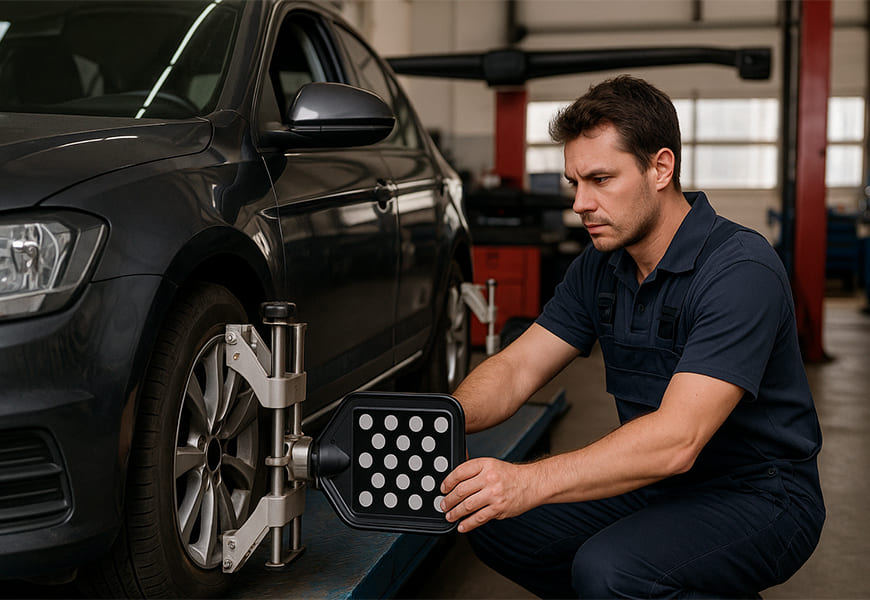
Proper wheel alignment is the foundation of safety and stability while driving. When the angles of the wheels are out of alignment, the car starts pulling to one side, tires wear out, fuel consumption increases, and the suspension works under higher load.
Autopark-Service in Lviv specializes in precise 3D wheel alignment and diagnostics of the suspension. In this article, we will discuss why the alignment goes off, how to identify the issue, and when exactly you need to perform the adjustment.
What is Wheel Alignment?
Camber — the tilt of the wheel relative to the vertical. It affects the evenness of tire wear and the behavior of the car in turns.
Toe — the angle at which the wheels “look” at each other from the front. It affects handling and stability.
When these angles are incorrect — the car doesn’t drive straight, the steering wheel turns asymmetrically, and the tires wear unevenly along the inner or outer edge.
Why Does the Wheel Alignment Go Off?
Wheel alignment can go off even without major impacts — just through regular use. However, there are specific causes.
Hitting Potholes, Bumps, or Curbs
This is the #1 cause of suspension geometry issues.
Even a single strong impact can:
- shift the wheel angles;
- damage control arms and bushings;
- cause subframe deformation;
- deform the shock absorber.
In Lviv, where the roads are often uneven, this is one of the most common reasons for visiting the service center.
Worn Suspension Components
Even without impacts, parts lose stiffness over time.
The following wear out:
- bushings;
- ball joints;
- steering rack ends;
- shock absorbers;
- springs.
Due to wear, the wheel changes its position, and the alignment automatically goes off.
Replacing Suspension or Steering Components
After suspension repair, alignment often needs to be done, even if the car seems to drive fine.
Alignment should be done after replacing:
- control arms;
- shock absorbers;
- springs;
- steering rack ends;
- steering rack;
- bushings / ball joints.
Incorrect Tire Pressure
Many drivers underestimate this cause.
Low or high pressure:
- throws off balancing;
- changes the “contact patch” of the tire with the road;
- causes uneven wear;
- makes the car unstable.
Wheel alignment doesn’t physically go off here, but the car’s behavior mimics a fault, so checking the pressure is essential.
Car Loading or Towing
If the vehicle often carries a load or tows a trailer, the rear end lowers, changing the suspension geometry.
This is especially true for:
- crossovers;
- vans;
- commercial vehicles.
Factory Defects or Corrosion
Rare, but possible:
- hidden geometric deformations;
- consequences of accidents;
- corrosion at suspension mounting points.
In such cases, extended diagnostics are required.
How to Tell If the Wheel Alignment Is Off?
Here are the main signs:
- The car pulls to one side. Even on a flat road, with no wind or slope influence.
- The steering wheel is crooked. It is turned left or right, even when the car is moving straight.
- Uneven tire wear — inner or outer edges are worn; “scalloping” of the tread.
- Vibrations or instability in steering. The car “floats”, it doesn’t keep the straight trajectory well.
- Fast suspension wear. When the angles are wrong, the suspension works under increased load.
How Often Should Wheel Alignment Be Done?
Autopark-Service recommends:
- Once a year — at a minimum. Ideally, once per season (spring / fall).
- After any strong impact. Hit a pothole? A check is mandatory.
- After suspension repairs. Even if the car seems to drive fine.
- Whenever there are any changes in the car’s behavior. Uneven movement, noise, vibrations.
How Is Wheel Alignment Done at Autopark-Service?
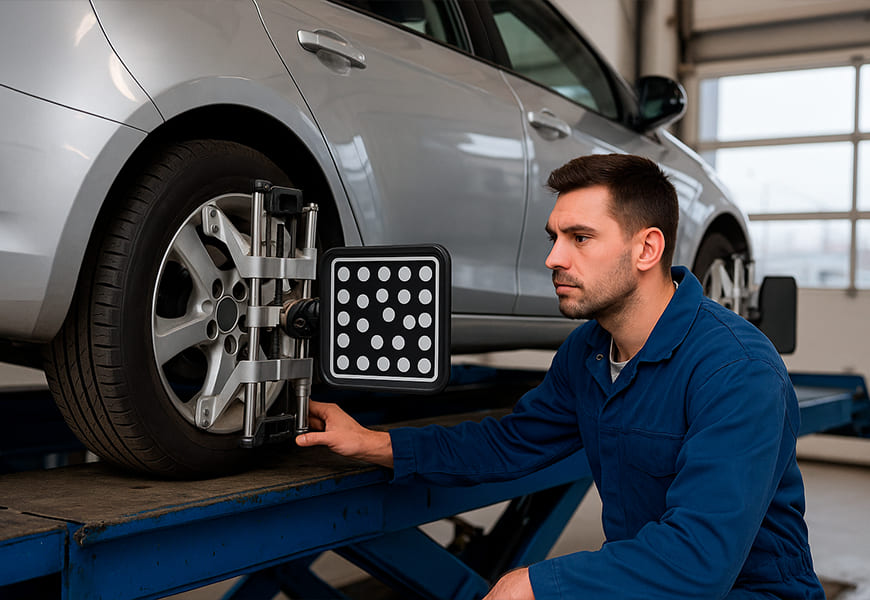
Our service center in Lviv uses a next-generation 3D stand that ensures maximum precision.
1. 3D measurement. A high-precision camera scans the position of each wheel.
2. Suspension inspection. The specialist checks:
- play;
- wear on the bushings;
- shock absorber condition;
- steering rack mounts.
3. Tire pressure check. This factor significantly influences the result.
4. Adjustment of angles. All available parameters are adjusted:
- toe of the front wheels;
- camber of the front wheels;
- sometimes — the rear axle (if the design allows).
5. Post-repair test drive. Checking the car’s behavior in real-world conditions.
How to Prevent Wheel Alignment Issues?
- avoid sharp impacts into potholes;
- check tire pressure every 2–3 weeks;
- replace worn suspension parts on time;
- perform diagnostics after any suspension repair;
- have a preventive 3D measurement once a year.
Conclusion
Wheel alignment is not just a manufacturer recommendation, but an important element of safety. If your car pulls to one side and the tires wear unevenly, this means that the wheel angles are wrong. The reasons can vary — from hitting a pothole to worn-out bushings.
Autopark-Service in Lviv offers professional 3D alignment, suspension diagnostics, and precise adjustment of wheel angles to ensure your vehicle is as stable, safe, and comfortable as possible.